For years I crossed to the opposite side of the street, or changed my direction, or turned a corner whenever I saw a police officer. PTSD caused my muscles to contract then quiver. Sweat beaded on my brow. My heart rate accelerated. My calves and thighs contracted as I prepared to run for my life. This was not because I was a criminal; but, because I had been a student protester in the late 60s and early 70s. I had been attacked and threatened with tear gas, pepper spray, bully clubs and bullets.
I was inspired by Thoreau, Mahatma Gandhi, and the Reverend Martin Luther King,Jr. to seek justice through peaceful protest and political action, to embrace the protections in the Bill of Rights which granted my free speech and right of peaceable assembly, and to redress the Government for redress of grievances.
As a child, I watched TV police dogs attack and bite civil rights protesters peaceably assembled, watched those protesters beaten into submission with clubs and guns, watched them shot, watched busses burned, watched water hoses knock down men, women and children. I watched those asserting their rights jailed and injured while handcuffed in cells.
Brutality seemed a “southern thing”; but racism was everywhere around me, in my Ohio town, my Catholic school, my Italian-immigrant and Appalachian-white neighborhood. We immigrants, who faced our own discrimination were too ready to discriminate against Black people, lest we be seen as within their fold. We Catholics who saw swastikas painted on our gym walls, who faced our own discrimination were too ready to discriminate against Black people for the same reason. The common thought expressed whenever anything difficult happened was “At least I am free, white and 21.”
Too many missed the point that if one person is denied freedom we all are; an un-provoked attack on any person is an attack on all of us, justice denied one person means justice is denied all of us. We pretend that we are safe because we are “free, white and 21”.
The trick of oppressors is to recognize racists, misogynists, homophobes and the poor that they suffer because of those they are willing to hate, not because of those who wield the power of oppression to greedily retain their wealth and power. No minimum wage increases, destruction of workers’ unions, ignoring the need to build affordable housing, food insecurity, privatized mental and physical health care system. It all works to the advantage of the oppressors.
On campus, women in my co-ed dorm had a curfew and sign-out book to record where we went after 6pm, with whom and when we would return. Men had no such requirement. We were punished with student judicial charges if we did not follow “the book”. I wrote a Declaration of Independence for the women of Lincoln tower and with other women removed the books and threw them into bonfire. Today, we would have been arrested. It ended the sign-out system when requests to the women’s Dean of Students (yes, there was a Dean for Men and a Dean for women) refused to take action on our behalf.
I participated in hunger strikes and sit-down strikes for transparency of crimes on campus, especially crimes against women and Black students. Crimes were not considered public information back then. One hunger strike resulted in the installation of emergency blue-light cameras strung across campus. They are still in place. We also protested and had hunger strikes for a Black Studies department, Black faculty and curriculum. Racial awareness programs and efforts, affirmative recruitment of Black students and Black faculty.
Meanwhile, students formed their own racial crisis-intervention practices and programs. The Student Government Association joined with the leader of Afro-Am in the development of a petition to address the issues of racism and need for a Black Studies Department. The petition included 19 items, initially. The student Leaders were denied a meeting with The President of OSU, day after day. Finally, they set up a card table and chairs in front on the administration building, waiting for him to acknowledge their presence and meet with them. Student organizers from across campus dorms, clubs, and student organizations decided to support the effort and called for a student strike.
The day before the strike was to begin I called the Secretary of the Board of Trustees, asking them to step-in and meet with Afro-Am and SGA leaders, or demand the president do so. I explained the growing unrest and pending strike, which would disrupt the educational mission of the university, He understood and agreed to call each board member and see if he could attain a quorum wiling to meet the leaders. Late that day he called, saddened to report that the board refused to meet or discuss my request for their intervention.
The next day, the strike was called and the requests had become a list of demands. A microphone was set p on the Oval and anyone could speak about the need for a university response. One of the first speakers was Woody Hayes, our beloved and irascible football coach who understood the demands and applauded us for remaining peaceful. The National Guard was ordered to campus. Its commander took the microphone to ask us to remain peaceful and told us although his soldiers carried weapons, they had not been issued bullets.
The following day a different commander addressed us to report the first had been removed from command and the soldiers were now fully armed and weapons loaded. The siege was on.
The protest lasted most of Spring quarter. Any group with a grievance climbed on the backs of Black students to seek their own agenda; feminists, LGBQ, environmentalists etc. Then, Cambodia was bombed and OSU became part of nation-wide student anti-war movement.
During this time we were tear-gassed, chased by jeeps with machine guns mounted on the back, sprayed with pepper gas; and helicopters flew over us dropping a yellow gas which exfoliated the trees and shrubs, browned out the grass, and caused the spring bulbs to keel over and die. It was a metaphor for what they did to us. Thousands of students, even those frat boys along fraternity row who collaterally were gassed and their frat houses shot up as students were chased by police along side streets, joined in the strike. The faculty of the Philosophy department conducted training and held classes on peaceful resistance, helping us orchestrate lie-ins and die-ins. We learned about sacrifice of the few for the rights of the many, among other philosophical treatises. I often brought food and water to the guardsmen, raiding automated food machines in my dorm. We handed them flowers and made peace with them, understanding they had no desire to kill us, and had to follow orders. Police cruisers circling the Oval would stop suddenly, an officer or two jump out and begin clubbing students sitting there, handcuff, arrest them and toss them into the back of the cruiser. We gave our floor “activity money” to campus clergymen to bail-out those arrested every day. The Ohio legislature later created a law to seize those fees for university control only, to avoid our use of our funds in a manner they disagreed with.
One day stands out. Maintenance was taking down the flag in front of the administration building where our leaders still sat and waited for an appointment. The group waiting with them began singing “America The Beautiful” in a very sarcastic voice. Some threw marshmallows toward the guardsmen who formed a triple-line between us and the flag, even though no one moved toward the flag. An order was given. The first line went to ground. The second line crouched down. The third line rested their guns on the shoulders of the second line. I was in front facing three soldiers. Our group became silent. A second order was given and we heard and watch guns cocked and ready to fire. We knew the next order would be “fire”. I looked into the eyes of the soldiers and ask tears held in check in fearful eyes. I whispered, “it is Okay.” I have no idea how long we stood there, frozen guardsmen and frozen protesters. But eventually the order was given to stand-down. I brought food and water again that night, dodging armed jeeps and cutting across a party no car had access to.
We were never invited to meet and discuss our demands. Martial law was declared by the Ohio governor. Students were ordered to not gather in groups exceeding 4 persons, or could be arrested. Civil rights were suspended. The thousands of us who gathered daily simply divide up into groups of 4 sitting no closer than 10 feet apart. The bully-club attacks continued. The gassing continued. We stayed. Most of us slept overnight knowing if we left the field the Oval would be cut-off to us. We held the field for those arriving in the morning to swell our ranks.
Until Kent State. Black students at Jackson State had been shot and killed a few days before Kent State. They were overlooked because Black lives have seldom mattered in America. But, when Kent State students died campuses were shuttered and students sent home; allowed back to take finals before dismissing for the summer. Campuses were reinforced for crowd control. Rules and laws were changed to undermine student organizing. Legislative hearings were held on campus, and facts suppressed. I attended the hearings. I recalled E.R. doctors from University Hospital appearing to report the nearly 30 students were shot during the protests, some left paralyzed. This had never been reported upon. The legislators asked the doctors to turn over the medical files they had brought to support their testimony. the doctors refused because medical records should be private, and because we “fear the information contained within will be suppressed.”
We have been in this space before:
Civil rights demanded and ignored.
Peaceful association branded harmful, protesters branded violent criminals.
Marshal law invoked to eliminate due process and civil rights guaranteed by the Constitution.
Use of weapons of war against civilians.
I have been called a “commie, pinko, radical, n…. -lover, racist”, since my teenage years into my mid-70s. I am a peace-lover, people-lover, nature-lover activist. All activists who embrace our constitutional rights are considered radical. We are trouble-makers when we question injustice and seek redress. Name-calling is meaningless to activists. We care not care what you call us because that is not us. We do care that you use name-calling to justify your own inaction, your own fence-sitting, your own unwillingness to facedown bullies. We bring attention to your deepest fears, while you insist there is nothing to fear. But, I tell you, there is something to fear.
We all should be afraid. I cannot watch scary movies. I face fear daily, for real. I cannot involve my consciousness in fake fears to entertain myself. I cannot look away from real suffering. I cannot sit on the fence and watch. I must act. I ask you to act, peacefully and continuously, “Until justice runs down like water, and righteousness lie a mighty stream.” And, know this: when you stir yourself to action, you will be attacked.
Once you find the courage to act, the emotional fear subsides. The physical attacks are more difficult. Mostly, because we never seem to expect human beings to be so cruel to us, fellow human beings. We know we are not behaving wrongly. We know we are not hurting others. We know we are not asking for anything we do not need, nor deserve. Why would anyone hurt us? Well, I have no answer because it is not a rational thing. There is no rational answer that applies to all. What I can do is offer some useful tips.
Check to see if parade-marshals are present. Listen to them and follow their instructions.
Wear shoes that are secure on your feet and allow you to run, and run fast. Wear socks.
Wear long-sleeves and long pants.
Pay attention to your surroundings and the people around you.
Note any inconsistent behaviors, especially violent rhetoric.
Try to stay upwind of police, note wind direction to avoid gas.
Wear a mask to avoid breathing in gasses.
Apply vaseline to exposed skin to avoid burns from pepper spray/pepper gas.
Note exit routes in case of attack, or stampede. Be ready to exit.
Move away from disputes, not toward them.
Employ the maxim, “Run away to fight another day.”
If arrest/removal is attempted go limp, lie down and allow peaceful removal. You can argue in court later through your attorney.
Do not block sidewalks, nor ingress and egress into buildings on your route.
Do not interfere with others going about their business.
Have videographers present to film.
Use camera to record incidents. Do not willingly turn over phones/cameras (without a warrant). Leave before anyone grabs them, and preserve images.
Have emergency number and agreed upon pick-up point in case you need to call for assistance.
Let others know where you are going to be and call when you finish to let them know you are safe.
Look out for one another. Calm others when they start to get agitated. It happens to the best of us.
Register with groups and organizers. They will help if things go haywire.
Peace overcomes war. Love overcomes hate. Stay in that space. When you no longer can, leave.
Come back and join in the next march, protest, sit-in,/die-in…and if you cannot physically engage in this way, offer financial support, write Letters to the editor, call your local-state-county and federal officials and representatives. And for goodness sake, vote as if our lives and our sacred honor as Americans rely upon you.
WE ARE BETTER THAN WE KNOW:HEAT WAVES AND HOT TOPICS,
By Louise Annarino,
July 1, 2012
The stress of enduring day after day of near and over 100 degrees heat with daily thunderstorms roaring through neighborhoods at 60-80 miles an hour uprooting trees, breaking off huge limbs, toppling trees and telephone poles onto cars and houses, plunging our cities and towns into darkness, isolating us from one another and formal information channels by shutting down cable television, and cell phone communication while we labor all day to clean up the mess and toss all night in the heat and humidity has been quite a test of patience and human kindness. Yet, we have endured. In fact, we have renewed our communities and our sense of belonging to one another. We have demonstrated lessons of fortitude and selflessness to our children. We are moving forward.
Neighbors have joined together to clear their streets and their lots of debris, pulling trees from right-of-ways, cutting them into manageable pieces, loading them on flatbeds and pick-ups, waiting in long lines to drop off their loads at city recycling lots to be turned into mulch for later on their neighbors’ yards and gardens. Citizens have worked to clear the storm debris alongside hundreds of private tree crews; while professional crews of power companies, hundreds from out of state, and city workers are able to access areas more easily and focus on doing what only they can do, what is beyond that of an average citizen’s ability, even when joined with neighbors in a common endeavor.
When every intersection must be treated as a four-way stop because lights are out and a normally 15 minute drive from Worthington to downtown Columbus takes merely 15 minutes more,I am surprisingly amazed. Because nearly everyone does act in communion with one another, and the few who cruise on through seem to be forgetful not self-serving, the process goes smoothly. We cooperate with one another with a mindfulness of our fellow travelers’ needs.
Customers are talking with one another and with the sales clerks, in darkened stores operating at half-power where the brightest light is the check-out screen on the electronic registers; and where clerks in stores with no power write up sales on a pad of paper, laughing with customers at their fumbling with this new old-way of doing things. Even the most taciturn among us join in these spontaneous conversations over where ice is still available and where gas pumps still work.
The mayor directed city workers to open fire hydrants during our over-heated afternoons so children can cool down, inviting them to play in the city’s fountains and water features. The memories of this struggle will be more joyful for our children and for us as a result of the mayor’s compassion and foresight. This is as it should be. This is what works. This is what moves us forward most quickly, no matter what the cause of our stress. This is what builds a strong community. We have easily shifted into a community of common interest where private citizens work alongside government workers and private company workers, and emergency personnel in government and private companies coordinate services for our common safety. While police cruise our darkened streets, National Guard soldiers go house-to-house checking to make sure our elderly are getting whatever help they need to survive the threatening heat.
When then-candidate Senator Barack Obama ran for president in 2007, I heard from a friend working for the Chamber of Commerce in southern ohio, and from another friend in northern Ohio that he had quietly made time to meet with local chamber leaders to discuss what Ohio needed to make our state economically strong, how business could be encouraged and strengthened, how his policies should be molded to assist small business owners in Ohio’s communities. At first, this surprised me. This was not a campaign stunt. Few people knew of these meetings. They were not being publicized, nor used as a campaign tactic for political gain. They were a sincere effort to learn more about Ohio’s business needs, and help Ohio’s employers and workers. It was, as I came to understand our president better, typical Barack: recognize we are all part of the same community, discuss our common concerns and needs, listen to the voices of others whom you know and of those whom you just met, learn from others, teach others, find common ground, plan how to improve things, offer a helping hand, work side-by-side no matter how difficult. That alone was enough to make me canvass so many hours for Barack Obama that I broke off bones in my foot from simple wear and tear.
How we have handled these climate-deranged days this week is a metaphor for how we must handle the challenges our nation faces as world economies shuttered and nearly stalled as a result of de-regulation and lack of institutional oversight of our business and banking enterprises, a strategy plotted, planned and financed by the U.S. Chamber of commerce, ALEC and fueled by Republican think-tanks. While Barack Obama was seeking common effort by recognizing the value of and including their ideas for a strong America, they were pledging to undermine every effort he made even those efforts which they had planned and initiated themselves under former administrations. Their goal was not to move us all forward, but to keep Barack Obama in the back of the bus.
If only they could have responded as our central Ohio cities and towns are responding to our latest crisis, as the good people of Ohio – Democrats,Republicans,Libertarians and Independents – are responding. Instead, our Governor John Kasich rejects transportation funds to build train routes reconnecting us to the rest of the country,tries to eliminate an avenue of communication with government workers by attacking collective bargaining, seeks to destroy and limit the economic and political power of unions representing hundreds of thousands of the government workers who keep our communities working safely and smoothly through crisis after crisis, and with his Lt. Governor Mary Taylor refuses to implement health care insurance exchanges offering Ohio businesses a structure to compete for health-care dollars. While he decries the nanny state he asks President Obama to declare Ohio in a state of emergency, to receive water, generators and other emergency supplies, cash and other assistance from agencies he has argued should be cut or eliminated. I hope the events of these last days and weeks have thwarted the excesses of his ideological position.
But it is not just our governor, it is every governor across the nation who invites in and colludes with carpet-baggers (Tea Party) of ALEC, Koch Brothers, Chamber of Commerce to override the good judgement and wisdom of Ohio’s citizens who work hard every day to make Ohio strong, productive, and safe for themselves, their children and their neighbors. It is our state representatives and senators who attend ALEC events and introduce ALEC-drafted legislation as their own who ignore the needs and wisdom of Ohioans. Ohioans awoke to one another and the need to work together for the common good during this heat wave;hopefully, they will wake up to political reality of Ohio and throw out all carpet-baggers and those who do their bidding.
The insistence that taxes must be cut, and that tax cuts for individuals earning more than $250,000 dollars per year must be maintained at the expense of all our people’s employment, the education of our children and the safety of each of us and hoping for some trickle-down is a disproven approach to sustainable economic growth. Every Ohioan who endures this heat wave, works to clear up after the damaging storm, and reaches out to neighbors and strangers knows better than these elected representatives. Ohioans are better than this and behave toward one another better than this. When Barack Obama reminds us in his public addresses “We Americans are better than that”, this is what he means. We are better than that.





 annarino writes
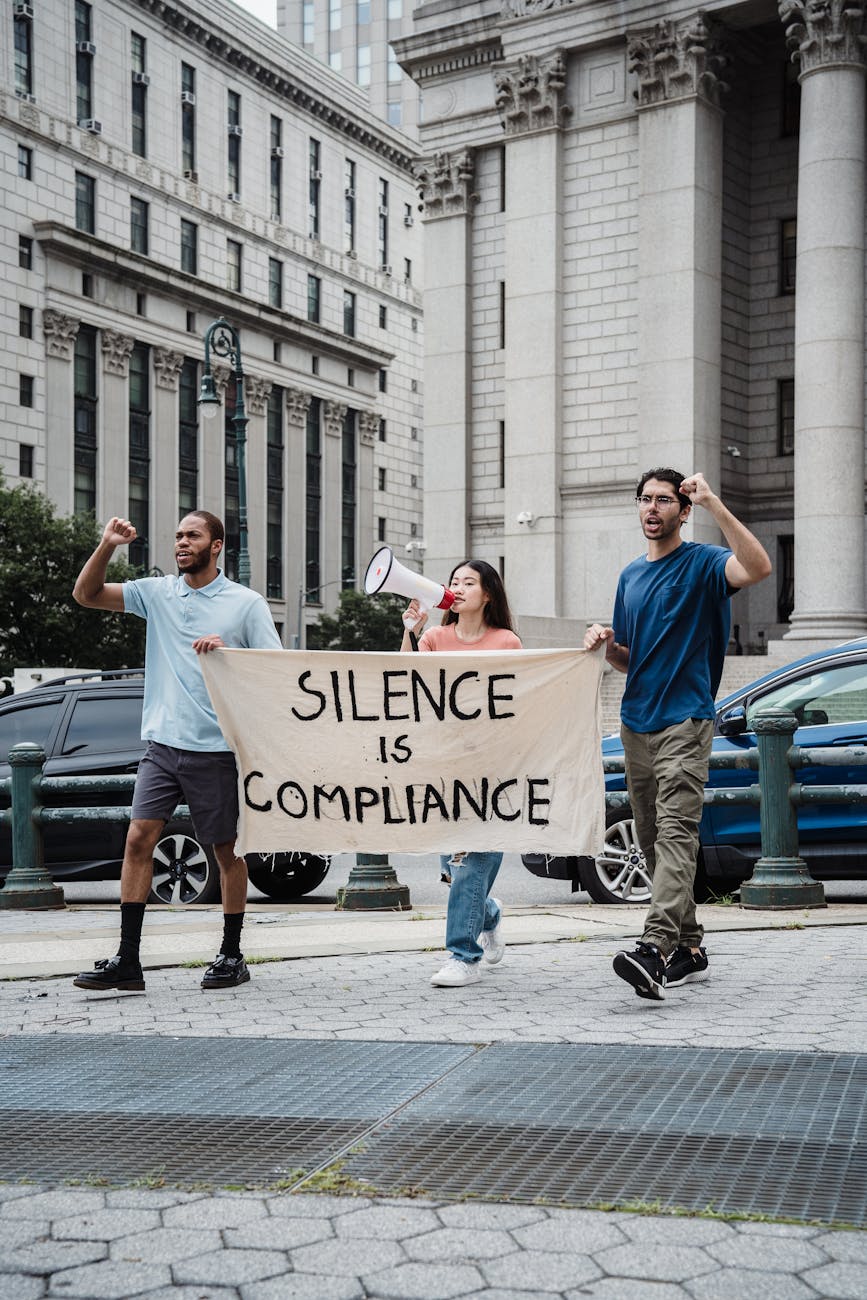
PROTEST NOTES
APRIL 5, 2025 AT A CORNER NEAR YOU
For years I crossed to the opposite side of the street, or changed my direction, or turned a corner whenever I saw a police officer. PTSD caused my muscles to contract then quiver. Sweat beaded on my brow. My heart rate accelerated. My calves and thighs contracted as I prepared to run for my life. This was not because I was a criminal; but, because I had been a student protester in the late 60s and early 70s. I had been attacked and threatened with tear gas, pepper spray, bully clubs and bullets.
I was inspired by Thoreau, Mahatma Gandhi, and the Reverend Martin Luther King,Jr. to seek justice through peaceful protest and political action, to embrace the protections in the Bill of Rights which granted my free speech and right of peaceable assembly, and to redress the Government for redress of grievances.
As a child, I watched TV police dogs attack and bite civil rights protesters peaceably assembled, watched those protesters beaten into submission with clubs and guns, watched them shot, watched busses burned, watched water hoses knock down men, women and children. I watched those asserting their rights jailed and injured while handcuffed in cells.
Brutality seemed a “southern thing”; but racism was everywhere around me, in my Ohio town, my Catholic school, my Italian-immigrant and Appalachian-white neighborhood. We immigrants, who faced our own discrimination were too ready to discriminate against Black people, lest we be seen as within their fold. We Catholics who saw swastikas painted on our gym walls, who faced our own discrimination were too ready to discriminate against Black people for the same reason. The common thought expressed whenever anything difficult happened was “At least I am free, white and 21.”
Too many missed the point that if one person is denied freedom we all are; an un-provoked attack on any person is an attack on all of us, justice denied one person means justice is denied all of us. We pretend that we are safe because we are “free, white and 21”.
The trick of oppressors is to recognize racists, misogynists, homophobes and the poor that they suffer because of those they are willing to hate, not because of those who wield the power of oppression to greedily retain their wealth and power. No minimum wage increases, destruction of workers’ unions, ignoring the need to build affordable housing, food insecurity, privatized mental and physical health care system. It all works to the advantage of the oppressors.
On campus, women in my co-ed dorm had a curfew and sign-out book to record where we went after 6pm, with whom and when we would return. Men had no such requirement. We were punished with student judicial charges if we did not follow “the book”. I wrote a Declaration of Independence for the women of Lincoln tower and with other women removed the books and threw them into bonfire. Today, we would have been arrested. It ended the sign-out system when requests to the women’s Dean of Students (yes, there was a Dean for Men and a Dean for women) refused to take action on our behalf.
I participated in hunger strikes and sit-down strikes for transparency of crimes on campus, especially crimes against women and Black students. Crimes were not considered public information back then. One hunger strike resulted in the installation of emergency blue-light cameras strung across campus. They are still in place. We also protested and had hunger strikes for a Black Studies department, Black faculty and curriculum. Racial awareness programs and efforts, affirmative recruitment of Black students and Black faculty.
Meanwhile, students formed their own racial crisis-intervention practices and programs. The Student Government Association joined with the leader of Afro-Am in the development of a petition to address the issues of racism and need for a Black Studies Department. The petition included 19 items, initially. The student Leaders were denied a meeting with The President of OSU, day after day. Finally, they set up a card table and chairs in front on the administration building, waiting for him to acknowledge their presence and meet with them. Student organizers from across campus dorms, clubs, and student organizations decided to support the effort and called for a student strike.
The day before the strike was to begin I called the Secretary of the Board of Trustees, asking them to step-in and meet with Afro-Am and SGA leaders, or demand the president do so. I explained the growing unrest and pending strike, which would disrupt the educational mission of the university, He understood and agreed to call each board member and see if he could attain a quorum wiling to meet the leaders. Late that day he called, saddened to report that the board refused to meet or discuss my request for their intervention.
The next day, the strike was called and the requests had become a list of demands. A microphone was set p on the Oval and anyone could speak about the need for a university response. One of the first speakers was Woody Hayes, our beloved and irascible football coach who understood the demands and applauded us for remaining peaceful. The National Guard was ordered to campus. Its commander took the microphone to ask us to remain peaceful and told us although his soldiers carried weapons, they had not been issued bullets.
The following day a different commander addressed us to report the first had been removed from command and the soldiers were now fully armed and weapons loaded. The siege was on.
The protest lasted most of Spring quarter. Any group with a grievance climbed on the backs of Black students to seek their own agenda; feminists, LGBQ, environmentalists etc. Then, Cambodia was bombed and OSU became part of nation-wide student anti-war movement.
During this time we were tear-gassed, chased by jeeps with machine guns mounted on the back, sprayed with pepper gas; and helicopters flew over us dropping a yellow gas which exfoliated the trees and shrubs, browned out the grass, and caused the spring bulbs to keel over and die. It was a metaphor for what they did to us. Thousands of students, even those frat boys along fraternity row who collaterally were gassed and their frat houses shot up as students were chased by police along side streets, joined in the strike. The faculty of the Philosophy department conducted training and held classes on peaceful resistance, helping us orchestrate lie-ins and die-ins. We learned about sacrifice of the few for the rights of the many, among other philosophical treatises. I often brought food and water to the guardsmen, raiding automated food machines in my dorm. We handed them flowers and made peace with them, understanding they had no desire to kill us, and had to follow orders. Police cruisers circling the Oval would stop suddenly, an officer or two jump out and begin clubbing students sitting there, handcuff, arrest them and toss them into the back of the cruiser. We gave our floor “activity money” to campus clergymen to bail-out those arrested every day. The Ohio legislature later created a law to seize those fees for university control only, to avoid our use of our funds in a manner they disagreed with.
One day stands out. Maintenance was taking down the flag in front of the administration building where our leaders still sat and waited for an appointment. The group waiting with them began singing “America The Beautiful” in a very sarcastic voice. Some threw marshmallows toward the guardsmen who formed a triple-line between us and the flag, even though no one moved toward the flag. An order was given. The first line went to ground. The second line crouched down. The third line rested their guns on the shoulders of the second line. I was in front facing three soldiers. Our group became silent. A second order was given and we heard and watch guns cocked and ready to fire. We knew the next order would be “fire”. I looked into the eyes of the soldiers and ask tears held in check in fearful eyes. I whispered, “it is Okay.” I have no idea how long we stood there, frozen guardsmen and frozen protesters. But eventually the order was given to stand-down. I brought food and water again that night, dodging armed jeeps and cutting across a party no car had access to.
We were never invited to meet and discuss our demands. Martial law was declared by the Ohio governor. Students were ordered to not gather in groups exceeding 4 persons, or could be arrested. Civil rights were suspended. The thousands of us who gathered daily simply divide up into groups of 4 sitting no closer than 10 feet apart. The bully-club attacks continued. The gassing continued. We stayed. Most of us slept overnight knowing if we left the field the Oval would be cut-off to us. We held the field for those arriving in the morning to swell our ranks.
Until Kent State. Black students at Jackson State had been shot and killed a few days before Kent State. They were overlooked because Black lives have seldom mattered in America. But, when Kent State students died campuses were shuttered and students sent home; allowed back to take finals before dismissing for the summer. Campuses were reinforced for crowd control. Rules and laws were changed to undermine student organizing. Legislative hearings were held on campus, and facts suppressed. I attended the hearings. I recalled E.R. doctors from University Hospital appearing to report the nearly 30 students were shot during the protests, some left paralyzed. This had never been reported upon. The legislators asked the doctors to turn over the medical files they had brought to support their testimony. the doctors refused because medical records should be private, and because we “fear the information contained within will be suppressed.”
We have been in this space before:
Civil rights demanded and ignored.
Peaceful association branded harmful, protesters branded violent criminals.
Marshal law invoked to eliminate due process and civil rights guaranteed by the Constitution.
Use of weapons of war against civilians.
I have been called a “commie, pinko, radical, n…. -lover, racist”, since my teenage years into my mid-70s. I am a peace-lover, people-lover, nature-lover activist. All activists who embrace our constitutional rights are considered radical. We are trouble-makers when we question injustice and seek redress. Name-calling is meaningless to activists. We care not care what you call us because that is not us. We do care that you use name-calling to justify your own inaction, your own fence-sitting, your own unwillingness to facedown bullies. We bring attention to your deepest fears, while you insist there is nothing to fear. But, I tell you, there is something to fear.
We all should be afraid. I cannot watch scary movies. I face fear daily, for real. I cannot involve my consciousness in fake fears to entertain myself. I cannot look away from real suffering. I cannot sit on the fence and watch. I must act. I ask you to act, peacefully and continuously, “Until justice runs down like water, and righteousness lie a mighty stream.” And, know this: when you stir yourself to action, you will be attacked.
Once you find the courage to act, the emotional fear subsides. The physical attacks are more difficult. Mostly, because we never seem to expect human beings to be so cruel to us, fellow human beings. We know we are not behaving wrongly. We know we are not hurting others. We know we are not asking for anything we do not need, nor deserve. Why would anyone hurt us? Well, I have no answer because it is not a rational thing. There is no rational answer that applies to all. What I can do is offer some useful tips.
Check to see if parade-marshals are present. Listen to them and follow their instructions.
Wear shoes that are secure on your feet and allow you to run, and run fast. Wear socks.
Wear long-sleeves and long pants.
Pay attention to your surroundings and the people around you.
Note any inconsistent behaviors, especially violent rhetoric.
Try to stay upwind of police, note wind direction to avoid gas.
Wear a mask to avoid breathing in gasses.
Apply vaseline to exposed skin to avoid burns from pepper spray/pepper gas.
Note exit routes in case of attack, or stampede. Be ready to exit.
Move away from disputes, not toward them.
Employ the maxim, “Run away to fight another day.”
If arrest/removal is attempted go limp, lie down and allow peaceful removal. You can argue in court later through your attorney.
Do not block sidewalks, nor ingress and egress into buildings on your route.
Do not interfere with others going about their business.
Have videographers present to film.
Use camera to record incidents. Do not willingly turn over phones/cameras (without a warrant). Leave before anyone grabs them, and preserve images.
Have emergency number and agreed upon pick-up point in case you need to call for assistance.
Let others know where you are going to be and call when you finish to let them know you are safe.
Look out for one another. Calm others when they start to get agitated. It happens to the best of us.
Register with groups and organizers. They will help if things go haywire.
Peace overcomes war. Love overcomes hate. Stay in that space. When you no longer can, leave.
Come back and join in the next march, protest, sit-in,/die-in…and if you cannot physically engage in this way, offer financial support, write Letters to the editor, call your local-state-county and federal officials and representatives. And for goodness sake, vote as if our lives and our sacred honor as Americans rely upon you.
Leave a comment
Filed under COMMENTARY, POLITICS
Tagged as 2025, Apri 5, Black Lives Matter, civil rights, courts, DOGE, due process, GAZA, Governor Rhodes, Hands Off, history, immigration, Israel, Kent State, Martial law, media, national guard, No Place for Hate, Ohio State University, Palestine, parade marshal, politics, propaganda, protest, racism, Republican candidates, republican convention, resist, sexism, Speaker Mike johnson, state of emergency, suppression of news, trump