Tag Archives: family

There is No War on Women,by Louise Annarino,1-25-2014

There is No War on Women,By Louise Annarino


There is no war on women. What we are watching play out is an age-old phenomenon of men who fear women’s sexual expression. Whether it is the Taliban, fundamentalist Muslims-Jews-Christians,or Mike Huckabee, the chastisement and need to control women springs from men’s fear of loss of their own control. I refuse to allow their fear to become my burden. I suggest they learn to handle it all, as I must handle my own fears. Their fear, their loss of control, is not my problem; but, they insist on making it so. I don’t call that a war. I call it fear mongering.


We use the word war too loosely. We enjoy hyperbole because it grabs our attention,holds our imagination, and allows us to believe we are heroes(another word used too loosely)fighting some grand battle. Anyone who has ever experienced war is insulted by this cavalier use of the word. Anyone who have ever acted heroically is appalled by its frequent use in today’s lexicon. As William Tecumseh Sherman who marched on Atlanta destroying all in his wake said in his address to the Michigan Military Academy in June 19, 1879, “You don’t know the horrible aspects of war. I’ve been through two wars and I know. I’ve seen cities and homes in ashes. I’ve seen thousands of men lying on the ground, their dead faces looking up at the skies. I tell you, war is Hell!” (Battle Creek Enquirer and News,Nov.18,1933). I cannot use the word “war” to describe anything but war. Fear is not war; and, unless we name what is happening correctly, we cannot address the problem we face correctly.


This fear of male loss of control when faced with female sexual expression has biological roots. http://www.webmd.com/balance/features/how-male-female-brains-differ Men’s brains are structured with less ability to maintain rational thought while in the throes of emotion. Of course they fear women whose brains allow them to cry,laugh,orgasm and think at the same time. Whom should we blame for this? The Hebrews tell a story of the first man and woman, Adam and Eve, in the Garden of Eden. Most of us have at least heard that story a time or two. There are two elements to that story: obedience to the male deity transferred to obedience to the first male, Adam. Who was to be obedient to these male prototypes? The woman. What do fig leaves have to do with the story? They are used to cover up human sexual expression, and thus control sexual expression which becomes sinful when the woman does not obey the man. That is what is going on today!


The Hebrews were not the first to tell such a story. Earlier cultures and religious traditions acknowledged the power of female sexuality; some accepted it and used it as an avenue to spiritual awakening a la the Vestal Virgins. Others fearfully suppressed it, a la female genital mutilation. We see vestiges of these practices today throughout our world. It is not only Mike Huckabee and Republican men who fear women. Democrats,Libertarians,Independents and a host of other men do, too. The men who do not fear women are able to trust and appreciate women, able to understand the biology of male/female differences without feeling inferior, and able to see diversity as an enriching experience,not one to be feared. There is that word “diversity” which too many of us fear. Such men exist within all political parties and religions.


Although I do not see such fear of women as merely a Republican issue, one must acknowledge that the Republican Party platforms have opposed Affirmative Action,our ONE effort to practice diversity; while the Democratic Party platform has embraced diversity.The Republican Party platform opposes women’s right to birth control and abortion,to freely manage her health needs to freely express her body’s sexuality; while the Democratic Party has embraced a woman’s right to choose how she uses her body sexually and how to protect her health. We cannot ignore that these two party positions are different, even though men are the same biological creatures, dealing with the same fears in both parties.


As a woman,I am not satisfied with the behavior of men in either party. It is not enough to add women to the mix, when the men make all the final decisions, and too often ignore and disparage our female voices. When women’s only strength comes from a separate women’s caucus, whose leaders are the strongest and wisest and most experienced political activists I know, rather than being hired into positions of political power we know we still have a long way to go. We may have “come a long way baby”,finally being allowed to participate in the race; but, the race officials-funders-judges are still men who too often control our political expression. The words men use to describe their view of women is not the problem. Their fear of women’s full and free use of her power is the problem. Huckabee apologists are busy trying to reframe how to control women as if male manners need fixed. Instead, they should focus on facing their own fears and finding their courage in the face of female power and sexuality.


Leave a comment

Filed under COMMENTARY, POLITICS

THANKSGIVING,By Louise Annarino,November 19,2013

It is easy to be thankful

for those whose love for us rolls easily

from their tongues, envelops us seamlessly

and shoulders us heavenly.

More difficult it is to be thankful

for those whose love growls coarsely,

binds us tightly

and holds us back fearfully.

Not all love is open, assured and courageous.

But, all love is true,

bears a message meant to be heard,

and shares a strength we may need

to make our own

that we may become someone

others may be thankful to know

and love.

Leave a comment

Filed under POETRY

Family Reunion,By Louise Annarino,3-9-2013

Family Reunion,Louise Annarino,March 9,2013


20,000 types of bees ?

Who knew

what I saw last summer,

the few types,

eight or nine,

flying

flower-to-flower

jaunts,

were merely cousins

from beyond my knowledge.

I will look harder

longer

with greater expectations

from now on.

Magnetic pull

from variety

increased diversity.

The mosaic

continues

with dollar plants

from Lowes.

Abbruzzis

or Abbruzzeses,

how many types of

us are there?

More spellings

than we can guess,

more stories to tell

than any one

can remember,

if we ever knew

what is in our DNA.

Like bees hovering

near the hive

we are most alive

when traveling far

to be near

the garden

where we reunite.


Leave a comment

Filed under POETRY

My Grandma Louisa Abbruzzi,By Louise Annarino,1-18-2013

My Grandma Louisa Abbruzzi,by Louise Annarino,1-18-2013


She brought me warm peaches

juicy pinks and yellow

from the fruit man’s cart –

just because I loved peaches.


She called me in from play

when my cousin tormented me

with threats of abandonment –

just because I needed acceptance.


She shared a nap with me

when no one would answer my questions

so she could tell me her stories –

just because I wanted to know.


She sang Neapolitan love songs

as I danced about the kitchen

on rainy days –

just because I needed to move.


She stroked my face

with hard, callused hands

worn rough tending ten children –

just because I needed soothing.


She grabbed my “rosie cheeks a la la”

and kissed me soundly,

painfully and laughingly –

just to make me giggle.


She dried my tears

with the hem

of her threadbare dress –

just because I treasured her comfort.


She spoke little English, but

she spoke the language of love.

I knew her only 8  short years.

I shall love her forever.

2 Comments

Filed under FAMILY STORIES, POETRY

Running To Catch Up,Louise Annarino,5-29-2012

RUNNING TO CATCH UP

ImageLouise Annarino

May 29, 2012

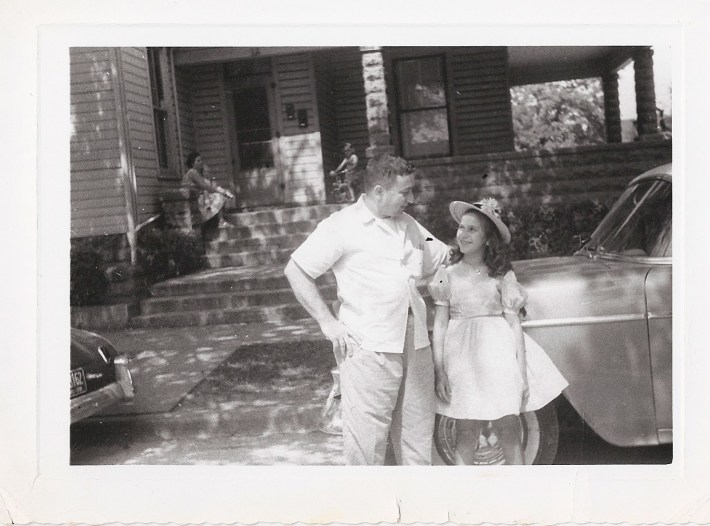
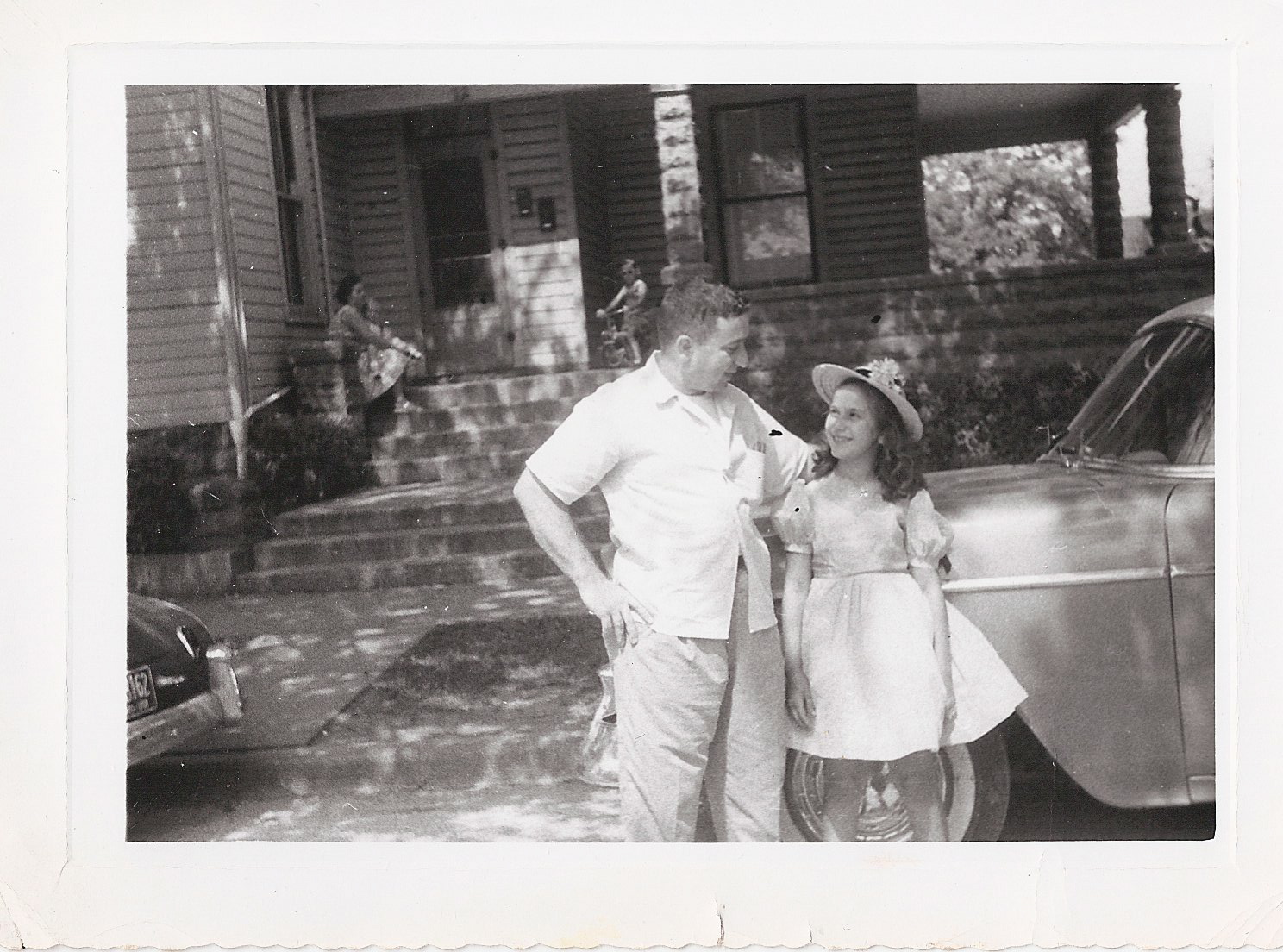
My first memories of my father are the most precious, foreshadowing our life-long relationship. My five feet four inch giant, happy-go-lucky father would scoop me up with both arms, lift me high with legs dangling, then tuck me into the crook of his right arm, both of us chuckling madly at our good fortune. I was just learning to toddle and could not keep up with my parents and three year old brother whose hand Mom kept in a firm grasp. As I got a older, it was Dad who held my hand, as Mom gripped the hands of both my older and younger brothers. They seemed a world apart from me and Dad. While Mom was intent on teaching the boys to walk like little gentlemen at her side, Dad and I were off on a merry jaunt.

While Dad loped along with an easy gait, my short legs scissored so fast to keep the pace I would trip. Up I went into Dad’s arms. He never slowed down, nor stopped grinning at me as if we held some grand secret, even as Mom chided him to slow down and let me walk! I can still see his discomfort trying to arrange the frilly dress and crinolines layered over his arm, while Mom rolled her eyes at him. He loved to make Mom roll her eyes. He would reward her with a kiss and a laugh.

Dad’s cousins had warned her before they married “Angelo is ornery.” Mom liked ornery. We all liked ornery. Dad worked long hours with his brothers John, Joe, and Frank and cousin Johnny “Dayton” running an Italian-American restaurant. Every other week, it was his turn to be home between 5 and 7 pm before returning to stay later to close. That meant we could have our supper all together.  We would fight over who got to sit next to Dad. Mom joked, only because she knew we could never afford a new one,she would soon buy a table with a hole in the center for Dad to sit in so we would each be near him.

Dad could draw the best cartoons and funny pictures, but he could not spell worth a darn. His notes to school would read, “please excuse Lousie from class as she had a sure throat and we had to keep her home.” “Lousie? Dad, you called me lousie! Sure throat?” I would protest. “Sister knows who you are,”answered Dad. “Don’t worry. Nobody’s perfect. It will give her a good laugh! She needs one.” She did. Most teaching sisters did need a good laugh. Most Moms, too. Dad kept them all laughing.

Mom could never threaten us with “Wait ‘til your Dad gets home.” Dad usually thought our daily shenanigans great fun. He would try very hard to keep a straight face as he berated us for some activity my Mother thought out of bounds. Then he would relate some of the trouble he got himself into as a kid, “one-upping” us every time.No one held their breath over Dad’s discipline.

It was Mom who chased us through the house with a wooden spoon to smack our behinds. She could not run very fast, she seldom got close enough to connect spoon to backside. Her aim was awful, too! Faking her frustration at her failure to get us, she would crack that spoon over the telephone bench so hard it broke in half. “Next time,” she would threaten, “when I buy a stronger spoon!” It took years, and many broken spoons, to realize Mom had had no intention of catching us.

The only time silence and tears welled up in us over Dad’s discipline style was when he took off his belt and ordered my older brother into the bathroom for a whipping, with Mom’s full support. I remember sitting at the table, looking at the faces of my younger brothers, our eyes open wide in fear, as the sound of the belt connecting was followed by Angelo,Jr.‘s tearful screams. As both Angelos rejoined a now solemn group of children at the table, my brother would be wiping the moisture from his face, his and dad’s eyes downcast, faces blushed in humiliation. We were the best-behaved kids on the block for at least the next twenty-four hours, an eternity to us.

It was not until one Thanksgiving at that same table, thirty years later that we learned the dirty little secret about Dad and Angelo. Taking his tight belt off so he could eat a second helping of Mom’s lasagna (yes,we had turkey and lasagna),we started a discussion about other instances where Dad had to take off his belt. The Angelos finally confessed that Dad would hit the clothes hamper with his belt instructing Angelo to fake screams. Before leaving the bathroom, Angelo would splash water on his face to create false tears. Both kept their eyes downcast when they rejoined the table to stop the laughter they each held back, blushing with the effort. All those years we had wondered why only Angelo ever got the belt.

Mrs. Rowe lived on the huge lot behind us which stretched from the side street all the way to the alley. Neighborhood kids played baseball there until she called “Kreager”, the truant officer, to report our trespassing. Kreager would tell Dad, stopping in for a drink at the restaurant before he headed down to the south-end to clear us out, so Mom could get everyone out of Mrs. Rowe’s yard before Kreager showed up. This seemed to make everyone happy for the moment and no one had to worry about going to juvenile hall for playing baseball in Mrs. Rowe’s yard. I once hid in the bushes along the alley edging her property and overheard Mrs. Rowe chastise him for being so slow in responding to her calls. She desperately wanted him to catch the “juvenile delinquents” in the act. Kreager answered her that she should be glad we wanted to play in her yard. Our poor neighborhood had no playgrounds, no place for kids to be kids. She should “do her part” and let us have a place to play so we did “not become juvenile delinquents,” he told her. In such overheard conversations are great truths revealed to children.

Mrs. Rowe had an ancient and fertile apple tree in her yard, just over the wall between us but not within reach of our short arms. The tree produced sweet,firm yellow-green apples on limbs far above our heads. The ground apples were fine for Mom to make applesauce, but not for eating. We stood slightly out from under the tree hurling the fallen apples, knocking the good apples to the ground where we would gather them up. Mrs. Rowe was no happier with chucking apple-pickers than with ball players. She informed us “I don’t want you kids in my yard knocking apples out of the tree. You can have any apple you find on the ground, but do not stand in my yard and throw apples at the tree.” This was no bother for Mom but left us dissatisfied until we got the bright idea to use the clothes-line pole to extend our reach.

We still had to find a way to reach those apples without standing in Mrs. Rowe’s yard, focusing on the stand in my yard part of her reproach. So, I stood on our wall and swung the pole out toward the tree, while my brothers waited below. Swinging the pole didn’t knock down a single apple but invariably knocked me off the wall. We gave up. The boys went off to play near the railroad tracks.

I went inside surprised to find Dad asleep in his chair on a rare afternoon break, while Mom fixed dinner. I awoke Dad and asked for his help outside. He came without question, still half-asleep. I placed him on the wall and handed him the pole, instructing him to start swinging the pole at the apple tree as soon as I climbed over the wall into Mrs. Rowe’s yard. I forgot to tell him about listening for the squeaky door hinge which would tip him off that Mrs. Rowe was about to discover us. That loud hinge gave me just enough time to hide in the bushes. Thus, when Mrs. Rowe came around the corner off her porch all she found was Dad, standing on the wall, swinging the laundry pole, apples flying out of her tree. “Mr. Annarino! No wonder your children are such delinquents. Shame on you.”

I waited until Mom called us all in for dinner, expecting a stern lecture or worse from Dad. Instead, as soon as he saw me Dad started laughing out loud asking, “Where on earth did you get to so fast? How did you know to run?” He thought it one of my best pranks, ever.  But, he admonished, it was one we could never repeat. With Dad,everything that happened in life was a cause for joy; and,learning life’s lessons was always fun.

Dad, Mom, Mr.Kreager, Mrs. Rowe – each of them so far ahead of us, with so much to teach us simply by being themselves. Each of them loving us and expecting us to grow into respectful and respected adults. But, it is Dad’s lessons and laughter I hold dearest. His ability to see the absurdity of rules, his ability to avoid the ordinariness of daily living by adding his own creative spark, his willingness to risk the haughty stares of others for a bit of good fun made every day a delight for us. We had no wealth, but we ate well. We never took vacations, but were always on vacation from disquiet and poverty. We worked hard within the harsh reality of the working poor, but we laughed harder than the seriously wealthy. Dad was a man on the go his entire life. He has been gone over 12 years. I am still running to catch up.

Leave a comment

Filed under COMMENTARY, FAMILY STORIES

WHAT ONE DADDY TAUGHT HIS LITTLE GIRL,Louise Annarino,1-18-2013

WHAT ONE DADDY TAUGHT HIS LITTLE GIRL,Louise Annarino


My daddy’s name was Angelo. He grew up without a Father to show him how to be a dad. His dad was a  skirt-chaser who left his wife alone to raise their four sons. Angelo was the baby. At age 3, when he lay on the sofa, dying from rheumatic fever which damaged his heart, the doctor went to his father to tell him so he could go visit his son and comfort his wife. Angelo’s father never showed up; not that day, and not until Angelo who was stronger than anyone could guess and thus survived, was in high school and old enough to help his father work his produce stand in the old Market Canal warehouse. Angelo cleaned the celery in buckets of ice water. His hands grew colder than the ice. But, his heart, his damaged heart, was always warm; especially for his little girl.


I was told that Daddy’s buttons popped off his shirt when his second child was born. Angelo was present in the room when I emerged from my Mother’s womb and he heard the doctor say, “You have a baby girl.” He had always wanted a sister and cherished the role of being a father to a little girl, and was thrilled  his sons (he would have three sons) would have a sister. He had done something his father had been unable to do. As a teenager, Angelo had discovered his father had secretly sired a daughter with one of his paramours, but Angelo never knew this sister. Angelo did many things his father had been unable, or unwilling, to do. The most important ?  He loved his children and was ever-present to them; an amazing feat for a man who worked 16 hour days, six days a week.


Daddy and his four brothers, one cousin, one retired uncle, and Angelo’s best friend ran an Italian-American family restaurant. At first, Mom did all the baking, and made pizzas. After I was born she stayed home to take care of my older brother and the brothers who came after me. Dad may not have been home much, but I always knew where to find him. Not once did I feel I had interrupted him. My presence in the restaurant was never questioned. I was as much at home there as in my own living room. Being where Dad was ? That was being “at home”.


These are things my daddy taught me:


  1. Being hugged, held and comforted can make the most difficult situation bearable. It takes away pain and builds one’s strength to allow others to offer comfort. I recall a day my mother had had enough of motherhood, and especially enough of me. Caring for a 3 year old son and a 1 year old daughter had taken its toll on her. She called my dad home from work to help her. When he arrived she told him “Take this child out of here ! I can’t do this today !” Daddy reached down and pulled me into his arms, cuddling me close and humming a sweet buzz in my ear as I hiccuped my cries. I felt his big thumb gently catch a huge tear sliding down my cheek. I looked into his eyes which were smiling at my own. I stopped crying. Daddy took me out and we went for a drive, giving Mom some time alone to calm herself and have a cup of tea while my brother napped. I never napped. While that was probably the real issue, I felt I was the issue. I often felt rejected by my mother. But, my father never rejected me. When I wet my bed at night and crawled over my mother to fit my wet-pajama self in between them, it was Daddy who soothed me and changed my sheets while Mom complained at the extra laundry I was creating for her. Daddy taught me that rejection by others, and their complaints about me, had more to do with their own needs than with me. He soothed my mother and he soothed me; blaming neither one of us. His compassionate understanding of human nature was one of Daddy’s greatest gifts to me.


  1. Money alone does not solve the problem of poverty. Daddy always  took me with him when he collected rent from Grandpa’s renters who lived on an alley near the railroad tracks downtown. We also rented a house from my Grandpa a few blocks away; but, ours was shingled and well-kept. This house was a run-down unpainted shack. Daddy took me because the renters had several small children, including a little girl my age. While he went inside to collect whatever rent he could, I played with the children in the front yard. Often, Daddy paid part of their rent rather than tell Grandpa they could not pay. He told me not to tell anyone. He explained that the people were doing the best they could do and he did not want the family to suffer. His job, he explained, was to help the parents relax and feel safe. My job was to help the children relax and feel safe. Being poor, he knew from experience, made children worry and feel scared all the time. Helping with money for rent was not enough; we needed to show people they could feel safe enough with us to enjoy life. His passion for life’s joys was something to share with everyone, even those who otherwise could not afford to simply enjoy life. His passion for helping others to enjoy life was one of Daddy’s greatest gifts to me.


  1. Girls have the same rights as boys. Every summer we went to Staten Island to visit with my mom’s sister Millie. Daddy drove us there and weeks later he returned to pick us up. He only stayed a few days before driving back. My Uncle Sal loved to go “crabbing”. What seafood feasts we had. One evening I overheard him and Daddy talking about what time Aunt Millie had to wake them and the kids, so they could string the cages and place them on the outgoing tidal floor. I was ecstatic to be able to join in. When I climbed in bed early so I was sure I could get up at 3 am, Uncle Sal informed me I was mistaken. “Only boys can come; it is no place for girls,” he stated. Crestfallen, I implored my Dad to let me go. My Dad who always included me when he pitched balls to the boys, taught us all how to block a tackle, connect with a boxing bag, and bait a hook would certainly allow me to go crabbing, too. He took one long look at me and calmly told Uncle Sal, “If my daughter cannot go, neither can I, nor my sons.” That is all it took. A willingness to make sacrifices so that everyone can be included in life’s opportunities was one of Daddy’s greatest gifts to me.


  1. It is not how one looks or dresses which makes a girl feel beautiful; it is how one is honored and cherished which makes her feel beautiful. And, being cherished is what every girl deserves. I started dancing school at age two. Every monday and wednesday evening and several hours every saturday until I was fourteen,  I was practicing at Marjorie Pickerell’s Dance Studio, a few blocks around the town square from my dad’s restaurant. After lessons I walked over to eat my dinner and Daddy would drive me home. He could never take off work for my recitals since they occurred during the busiest part of his work day.  But, he came to a recital once, at the close of my routine, which was the close of the recital. That year the recital theme was “The Wedding”. I danced as the bride; the wedding was the final number. I wore my frilly white First Communion dress and veil as my wedding costume. But it was not the dress that made me feel beautiful; it was Daddy. My partner groom and I had just left the stage to applause, when Marjorie ushered me back out onto the stage to take an encore bow. There, at the base of the stage, between the footlights which blocked out all the audience but allowed me to see him was the man who cherished me. Still dressed in his standard black pants, white shirt, and stained full-length white apron stood my Daddy with a huge bridal bouquet which he presented to me as though I were the world’s greatest ballerina, to much audience laughter and applause. He had only seen me dance in his mind’s eye, but what he saw was beautiful. And so, I was. Giving me a sense of my own beauty was one of Daddy’s greatest gifts to me.


  1. Racism was omni-present in my world. It was something I knew I had to stop. As a second generation Italian-American I grew up hearing stories of prejudice endured by my family and friends. However, our ordeal was minor compared to what I saw African-Americans endure. I was incensed by the fact that there seemed no escape for them, as there was for me. When I read about apartheid I was stunned that our government continued to do business with South Africa and Rhodesia. “Then, do something about it”, Daddy entreated me. “I’m only 10 years old,” I argued. His close childhood friend, Republican John Ashbrook had been elected a congressman and Daddy suggested I meet with him when he came home for constituent meetings. On a saturday morning I climbed into a chair meant for an adult, and asked Congressman Ashbrook sitting at his desk in the Licking County courthouse how he could justify his recent vote to buy chromium from Rhodesia when that government continued its policy of apartheid. We discussed the Rhodesian issue and the issue of American racism at length. From then on, Congressman Ashbrook and I began a lifelong correspondence. He sent me copies from the congressional record of any reference to racial issues at home and abroad. The complexity of issues and the detailed efforts to chart a corrective course through the halls of congress became clear to me. Although I remain a liberal and Mr. Ashbrook was a strong conservative we were able to reach consensus on many issues. That is what Daddy wanted me to learn. Life is difficult. Problems are thorny. Nothing is perfect. But, we must make every effort to change our world for the better and we can only do so by engaging those with whom we disagree. It is easy to complain among our friends; but, hard to solve problems with those with whom we disagree. Showing me that no matter what my limitations, I must do my very best to resolve problems, going as far as possible no matter how foolish I felt, was one of Daddy’s greatest gifts to me.


  1. After my first year of law school, Congressman John Ashbrook offered me a summer internship in Washington, D.C. I was preparing to drive from Cincinnati to D.C. when I got a call from the congressman, “Louise, I am so sorry, but I was at the restaurant last night talking with your Dad and I have to withdraw my offer. You cannot work for me this summer.” It seems Daddy told Mr. Ashbrook that their 40 years of friendship were over unless he withdrew the job. Daddy felt Washington was not a safe place for a young woman, despite Mr. Ashbrook’s assurances he would keep an eye on me. After much wrangling, he gave into Daddy and called me. My faith in all I believed about Daddy was crushed in that single phone call,even as my love for him endured. I could not understand his lack of faith in me. Years later, my youngest brother served as an intern for Congressman Ashbrook for two summers, while he studied law. I asked Daddy why he allowed my brother to go to Washington, but blocked my opportunity. He answered that my brother was more selective than I, more cautious than I and, therefore, less likely to get himself into a situation he could not handle. I, on the other hand, never saw a situation I did not think I could take charge of, was afraid of nothing and no one, and constantly sought out the most difficult challenges – those no one else was willing to take on. And he added, “sexism”. I finally understood that Daddy had not lost faith in me. He knew exactly who I was and felt he needed to protect me; not from Washington, D.C. but from myself. It took courage to do that. He risked my love for him to protect me. I still disagree with his decision because I still think I can handle anything. I have proved my Daddy’s case. Learning to accept who I am, who those I know and love are, warts and all, was one of Daddy’s greatest gifts to me.


My Daddy lives on in my sense of self. His gifts to me are endless. Many little girls are fortunate to have similar stories about their daddies. Too many little girls have no such stories. Let us remember our daddies. And, let us pledge to do all we can to create a community where every little girl can grow up with such daddies. There is much to do. As Daddy would say, “Stop your bellyaching and go do something about it !”


Leave a comment

Filed under COMMENTARY, FAMILY STORIES

PROTESTING IDENTITY,by Louise Annarino,1-4-2013

PROTESTING IDENTITY,by Louise Annarino,1-4-2013


In the midst of campus chaos at OSU I went home one week-end. Week-ends are busy for restaurant owners; so, as usual, if I wanted to see my dad I had to go to the Center Cafe. It was usually a rewarding experience to be welcomed by Dad, my uncles and their regulars. Uncle Joe would boom out a hearty, “Hey, it’s my niece. Say hello to her everybody!” Uncle Frankie would quietly grin and ask, “Want  cheese on that body builder?”, as he placed a burger on the grill. Uncle Johnny would uncap a cold coke, fill a glass with ice and pass it across the bar to me with a “Hey kiddo!” Dad would come from behind the bar, give me a kiss on the cheek, motioning me to a booth where we could talk. It was homecoming to my second home.


That Saturday morning, It was not surprising to see a new American flag hanging on the wall of the entrance foyer; there were three equally large flags  hanging above the booths running along the wall across from the grill and bar in the front dining room. Each flag had been flown above the U.S. Capitol and gifted to the brothers by a congressman or senator. What did surprise me was the hand-written sign hanging in the entry foyer “Protesters and hippies will not be served. America! Love it or leave it.”


I stood there a moment wondering what kind of welcome to expect this time. Barefoot, a tie-dyed scarf for a top, cut-off jean shorts with a shredded hem, and a triangled-flag scarf on my head, tied at my nape to hold back, my waist-length hair; I looked a proverbial hippie. I had been protesting the racism,sexism and homophobia on the OSU campus for two years. Now, our protest had merged with anti-war protests across the country, and I was boycotting classes. I came home hoping to find a safe refuge, a peaceful respite from the constant turmoil and endless disputes, from the gassings and shootings.


Pointing out the sign, I asked my uncles, “Are you sure you want to serve me? I am one of those protesters you dislike so much.” They each smiled their crooked smiles, not their usual ear-to-ear grins and said, “Sit down and eat. You look like you are ready to disappear.” In order to love me they refused to see me. I had disappeared the minute I entered the restaurant.

Leave a comment

Filed under COMMENTARY